
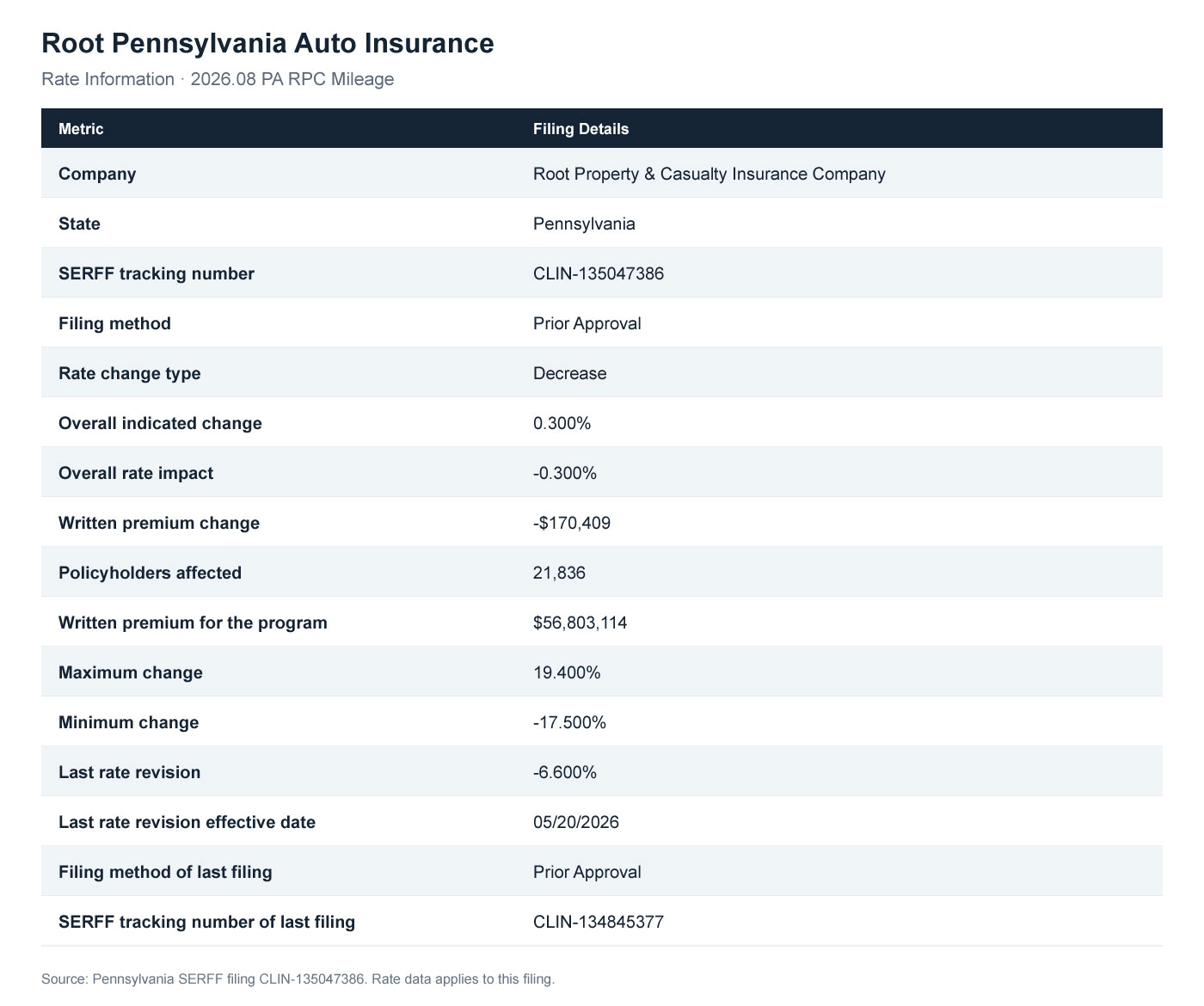
Root has secured approval to revise its Pennsylvania auto insurance pricing, with an overall rate decrease of 0.3%. The more consequential change concerns how the company uses distribution channels to assign underwriting tiers—and the limits Pennsylvania placed on those assignments at renewal.
Approved October 21, the filing affects 21,836 policyholders representing approximately $56.8 million in written premium. It takes effect November 3 for new business and December 6 for renewals.
Root explained that its channel-based tier revisions reflect differences in the business coming through its distribution sources.
“We make periodic revisions to the channel feature associated with policy tier, based on different loss and expense experience across our production channels,” the company told regulators.
The exchange highlights how distribution decisions feed into underwriting: Root evaluates channels based on their loss and expense experience, then incorporates those differences into tier placement.
Pennsylvania questioned whether revisions to channel features could move existing customers into higher-rated tiers at renewal. The department noted that Root’s previously filed underwriting rule allowed tier changes only to a lower-rated tier.
Regulators presented two options: retain distribution channel within underwriting tiers and enforce the restriction on upward moves, or move it into the rating classification plan. The latter would require a public filing, with any request for confidentiality supported by a legal argument establishing trade-secret protection.
Root chose to retain its existing structure.
“We have evaluated both options and decided to keep the distribution channel in the underwriting tier,” the company wrote. “As a byproduct of this decision, we will enforce the condition that no policyholders would be moved to a higher tier at renewal.”
That commitment limits upward tier movement at renewal; it does not freeze renewal premiums. The filing reports individual rate impacts ranging from a 17.5% decrease to a 19.4% increase despite the small overall reduction.
The review also illustrates Root’s pace of pricing adjustments. Pennsylvania identified the proposal as its third rate change within a year and required the company to revise its actuarial assumption about how long rates would remain in effect from one year to six months.
For Root, the approval preserves distribution channel as an underwriting input while constraining how changes to that input can affect existing customers at renewal.
